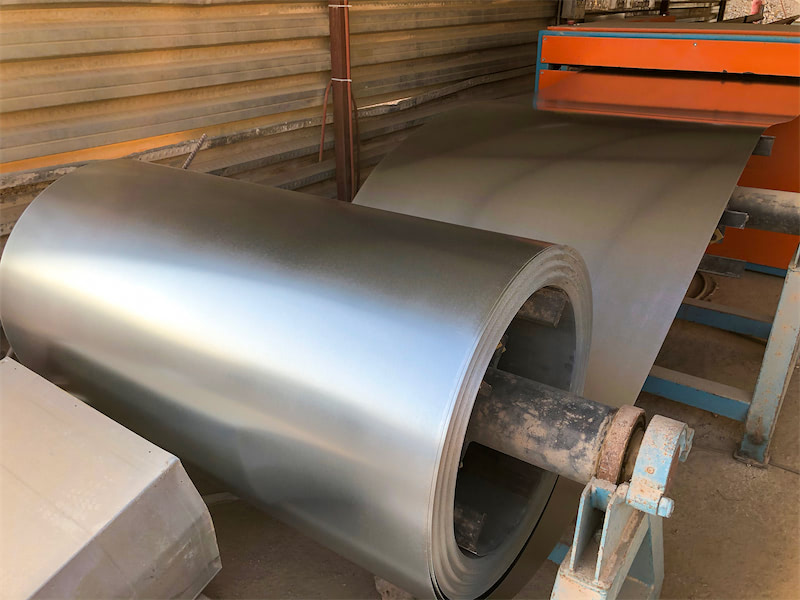
The Shanghai Futures Exchange organized a forum on stainless steel futures in Wuxi in late December 2017. Stainless steel cold rolling futures lasted 2 years of research and design, 5 meetings, the market is optimistic that stainless steel will be listed as early as the second quarter of next year (before June 2019).
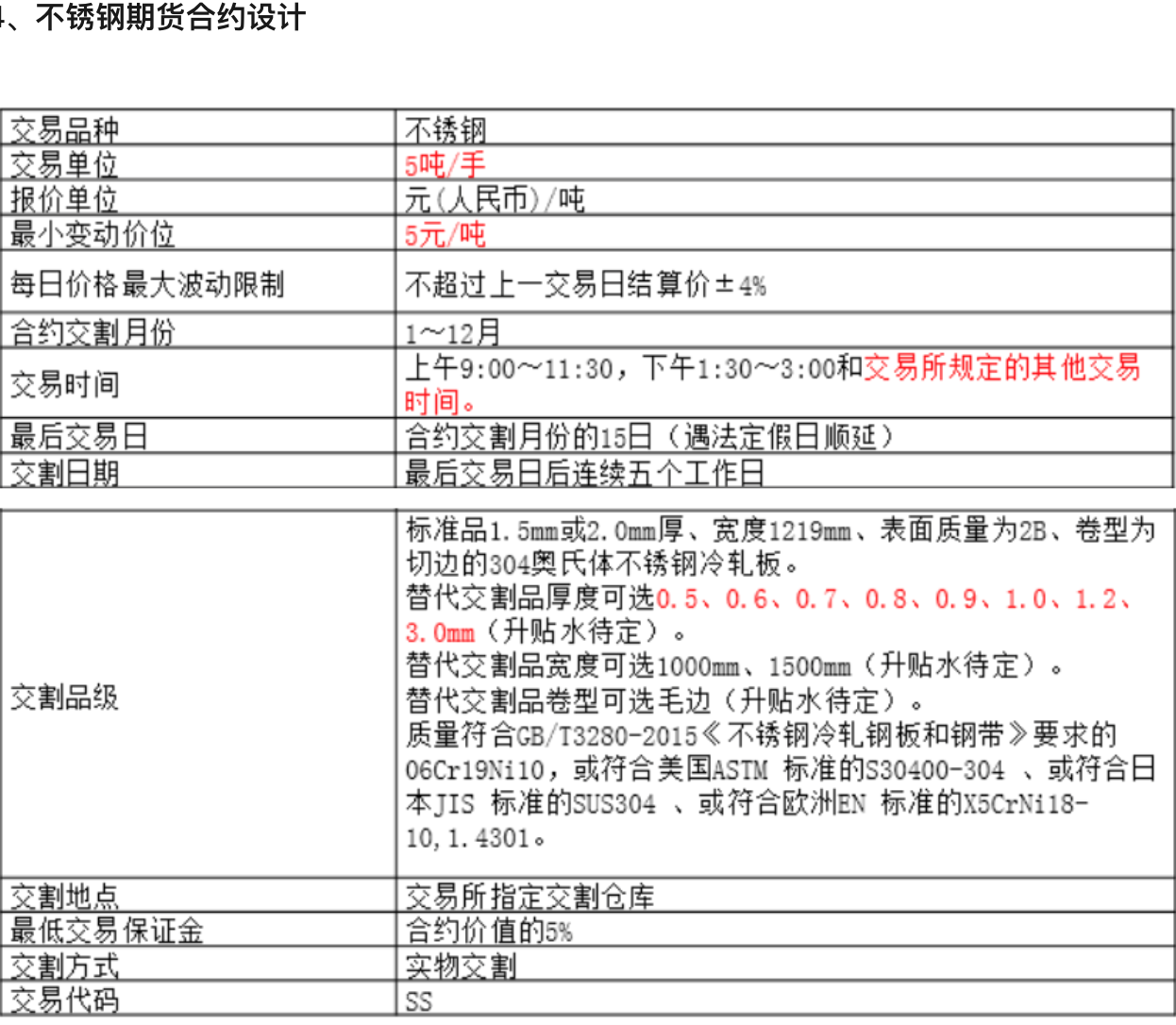
The market has been full of expectations for this new futures variety, with the "Dongfeng" of stainless steel futures, today we will comb the stainless steel process, policy, production capacity, as well as the current and future development.
Process, Technology and History of stainless Steel smelting
Stainless steel has many excellent properties, beautiful appearance, long service life, can be recycled 100%, so it has been widely used.
Stainless steel production process
The most basic production of stainless steel is divided into three steps: steelmaking, hot rolling and cold rolling.
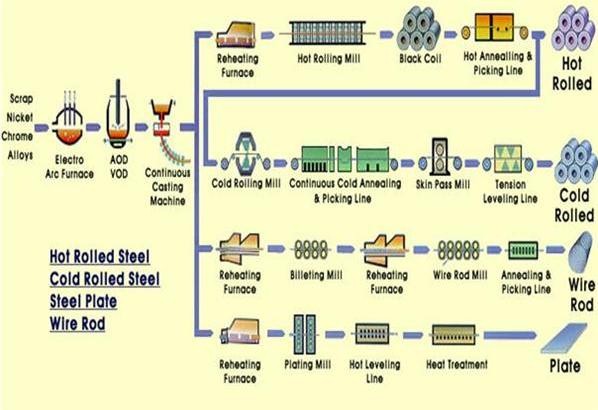
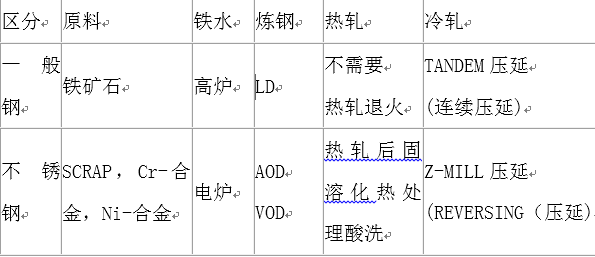
1. Steelmaking and manufacturing works:
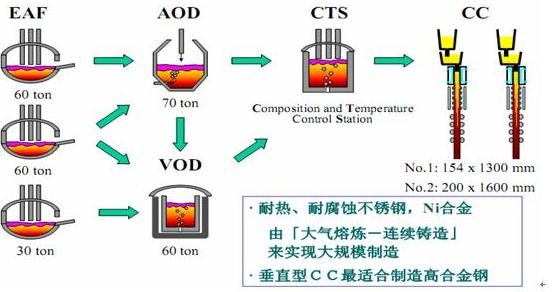
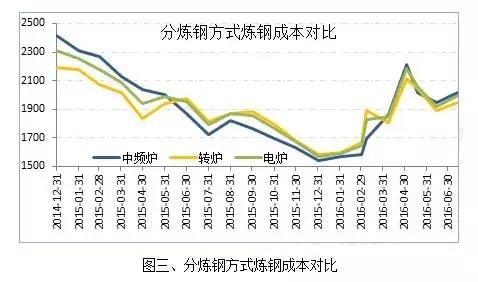
Comparison of refining methods
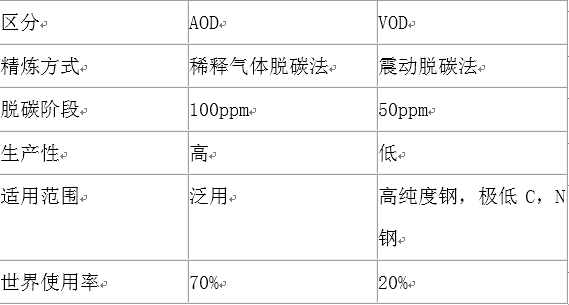
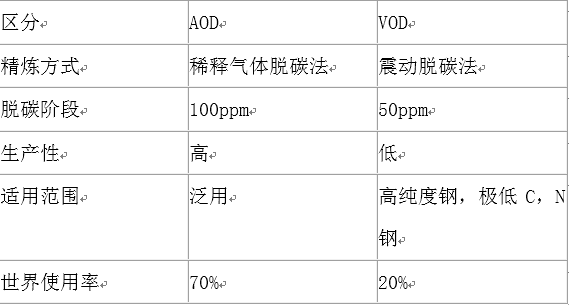
There are two ways of hot rolling: hot continuous rolling and reversible rolling
The main results are as follows: (1) Hot continuous rolling: hot continuous rolling products are rolled into strip by rough rolling mill and finishing rolling mill after heating, which is formed once from a single direction by using slab (mainly continuous casting billet) as raw material.
(2) reversible rolling: hot continuous rolling products are rolled into strip steel by rough rolling mill and finishing rolling mill after heating with slab (mainly continuous casting billet). The finishing mill adopts reversible blasting machine and is formed by repeated rolling. Steckel mill is generally used. The key of Steckel mill lies in coiler and coiling hot heating furnace, which is suitable for plate and strip production line or special steel strip production line where the output requirement is not so high.
III. Cold rolling
Generally speaking, the cold rolling mill used to produce stainless steel mainly uses 20-high rolling mill. Because of its good stiffness, it is widely used in the production of stainless steel.
Analysis and comparison of stainless Steel production and smelting process
At present, the smelting process of stainless steel in the world is mainly divided into one-step process, two-step process and three-step process. The two-step process of EAF+AOD (electric arc furnace + argon oxygen refining furnace) accounts for about 70%, and the three-step process accounts for about 20%. As low phosphorus hot metal is widely used in stainless steel production, the new one-step stainless steel smelting process is also adopted by more and more stainless steel production enterprises.
One-step stainless steel smelting process
The early one-step stainless steel smelting process refers to the melting, decarburization, reduction and refining of scrap steel in an electric furnace. With the continuous development of out-of-furnace refining process and the wide application of AOD furnace in the field of stainless steel production, this one-step smelting process of smelting stainless steel only by electric furnace has been phased out because of its long smelting cycle, low operation rate and high production cost.
At present, many stainless steel production enterprises use part of low phosphorus or dephosphorized hot metal instead of scrap, hot metal and alloy as raw materials into the AOD furnace for stainless steel smelting, resulting in the formation of a new one-step smelting process. Compared with the early one-step process, the new one-step smelting process cancels the smelting link of electric furnace in the production process. Its advantages include: first, reducing investment; second, reducing production cost; Third, blast furnace hot metal smelting reduces the burden cost, reduces energy consumption, and improves the purity of molten steel; fourth, the scrap ratio is low, which adapts to the existing scrap steel market; fifth, it is particularly economical for smelting 400 series stainless steel.
However, the new one-step method has certain requirements for raw material conditions and product scheme: first, the phosphorus content of hot metal in AOD is less than 0.03%, so the hot metal dephosphorization treatment should be added in the smelting process; Second, it is not suitable for stainless steel varieties with complex composition and high alloy content.
At present, the new one-step stainless steel production process is widely used in the production of 400 series stainless steel. As a developing country, China lacks scrap steel resources and is extremely poor in nickel. In addition, 400 series stainless steel is more and more widely used in daily life and industrial production. These objective conditions make the new one-step stainless steel smelting be adopted by more and more production enterprises.
Two-step stainless steel smelting process
The representative process routes of two-step stainless steel are EAF / AOD and EAF / VOD (electric arc furnace / VOD vacuum refining furnace). At present, the production capacity of EAF / AOD process accounts for about 70% of the world's stainless steel production capacity, in which EF furnace is mainly used to melt scrap and alloy raw materials to produce stainless steel pre-melt, and stainless steel pre-melt is then smelted into AOD furnace to produce qualified stainless steel molten steel.
The two-step stainless steel smelting process is widely used in the production of various series of stainless steel. Its advantages include: the electric furnace has low requirements for raw materials, the production cycle is slightly shorter than the one-step process, and the flexibility is good. It can produce 95% stainless steel in addition to ultra-low carbon and nitrogen stainless steel.
However, in the two-step process, attention should still be paid to the following three points in terms of medium consumption and variety scheme: first, with the progress of the smelting process and the improvement of the operation level in recent years, the consumption of argon and other media in the two-step smelting process has been significantly reduced. However, the consumption of argon and other media is still slightly larger than that of one-step method and three-step method. Second, when the decarburization of AOD furnace reaches the end point, the oxygen content in molten steel is high, so ferrosilicon must be added to reduce oxygen in molten steel, so the consumption of ferrosilicon is high; third, it can not be used to produce ultra-low carbon and nitrogen stainless steel at present, and the gas content in steel is high.
Three-step stainless steel smelting process
The basic technological process of the three-step process is as follows: initial refining furnace combined blowing converter / AOD furnace vacuum refining device. Three-step method is an advanced method of smelting stainless steel, the product quality is good, suitable for professional manufacturers, but also suitable for the production of stainless steel in United iron and steel enterprises.
The three-step method of stainless steel adds the link of deep decarburization on the basis of two-step method. Its smelting process has the following advantages: first, the division of labor of each link is clear, the production rhythm is fast and the operation is optimized; Second, the product quality is high, nitrogen, hydrogen, oxygen and inclusion content is low, can produce a wide range of varieties; third, hot metal smelting can be used, the requirements for raw materials are not high, and the selection of raw materials is flexible.
However, the three-step stainless steel smelting process realizes the metallurgical function step by step, which will have the following impact on the production investment: first, the process link is increased, the investment and production cost is higher; second, the vacuum equipment system is complex and the maintenance quantity is large.
Process selection of stainless Steel Plant in China
The process selection of combined steel enterprises is relatively more flexible.
The raw material conditions, production scale, product scheme, operating cost and workers' operating habits of stainless steel production enterprises will affect the choice of stainless steel smelting process. As raw materials, operating costs and product schemes are greatly affected by market fluctuations, the selection of production process in modern stainless steel smelting workshop should have certain flexibility, and the production process and product scheme can be adjusted according to market conditions.
Most of the large stainless steel production enterprises in China are combined iron and steel enterprises, such as Taiyuan Iron and Steel Co., Ltd., Jiuquan Iron and Steel Co., Ltd., Baosteel and other enterprises, which produce both stainless steel and carbon steel. For these combined iron and steel enterprises, the range of raw materials is relatively wide, there is not only an adequate supply of hot metal, but also scrap steel to meet the needs, these enterprises have greater flexibility in the choice of stainless steel smelting process route.
Smelting process of stainless steel in Taiyuan Iron and Steel Co., Ltd.
Taiyuan Iron and Steel Co., Ltd. has three stainless steel smelting workshops, namely the third steelmaking Plant, the second steelmaking Plant South District and the second steelmaking Plant North District.
The smelting process adopted by the third steelmaking plant is as follows: EAF / AOD, mainly produces duplex stainless steel, heat resistant steel, high alloy stainless steel and high added value stainless steel. The smelting process adopted in the southern district of the second steelmaking Plant is as follows: hot metal pretreatment K-OBM-S furnace VOD LF furnace, which is mainly used for the production of ferrite and martensitic stainless steel. The smelting process adopted in the north area of No. 2 steelmaking Plant is as follows: dephosphorization converter / AOD / VOD and electric furnace / AOD / LF/VOD. The process path in the north area of the second steelmaking plant is flexible, which can be used not only to produce stainless steel by a new one-step method, but also to produce stainless steel by two-step method and three-step method.
II. Smelting process of stainless Steel in Jiuquan Iron and Steel Co., Ltd.
The smelting process of stainless steel steelmaking workshop of Jiuquan Iron and Steel Co., Ltd. is configured as follows: 1 hot metal tank top spray dephosphorization station, 1 dephosphorization converter, 1 EAF, 2 AOD, 2 LF refining furnaces. Its products cover a wide range of products, including 200 series, 300 series and 400 series stainless steel.
The stainless steel steelmaking workshop of Jiuquan Iron and Steel Co., Ltd. mainly adopts the following two processes for stainless steel smelting: one is that the top of hot metal tank EAF / AOD / LF, is a two-step production process, which is mainly used to produce 200series and 300series stainless steel; The second process is that the dephosphorization converter AOD / LF, is a new one-step production process, which is mainly used to produce some steel grades of 400 series.
III. Smelting process of Baosteel stainless Steel Branch
The stainless steel production process of Baosteel stainless Steel Branch is configured as follows: 2 hot metal tank top spray dephosphorization stations, 2 120tEAF, 2 135tAOD, 1 LTS treatment station and 1 120tVOD.
The technological process adopted by Baosteel stainless Steel Branch is more diversified. Flow 1: hot metal tank top spray dephosphorization EAF / AOD LTS treatment station / VOD, production of 200series, 300series and 400series stainless steel, flow 2: hot metal tank top spray dephosphorization AOD VOD, production of 200series and 400series of steel; Flow 3: electric furnace AOD / LTS treatment station / VOD, production of 200series, 300series and 400series stainless steel.
From the above comparative analysis, Chinese large stainless steel production enterprises take the new one-step and two-step process as the main process of stainless steel production, and use the three-step process only in the production of ultra-low carbon, nitrogen and other high-quality stainless steel.
Choose the process route according to local conditions
The determination of stainless steel smelting process route should first take the product outline as the starting point, and choose the appropriate stainless steel smelting process route on the basis of the raw material composition and stainless steel refining mechanism of stainless steel smelting. For large stainless steel production enterprises, the configuration of process equipment in the workshop should be able to meet the requirements of diversified process routes, so as to meet the needs of large fluctuations in raw material prices, update and select the best raw material ratio scheme at the right time. At the same time, the smelting equipment should be able to meet the smelting process of different raw material ratio.
Due to the lack of scrap resources of stainless steel in China, the high burden cost of stainless steel smelting process with scrap as the main raw material, the high energy consumption of full scrap steel smelting, and the poor quality of scrap steel, there are many harmful elements in molten steel. More and more stainless steel manufacturers in China tend to use dephosphorized blast furnace hot metal to smelt stainless steel. Especially in the combined iron and steel enterprises, the cost of raw materials per ton of steel can be effectively reduced by using the blast furnace of the carbon steel system to supply part of the hot metal to the stainless steel smelting system. At the same time, dephosphorization treatment facilities are widely used in stainless steel production process. The application of dephosphorization treatment facilities can not only reduce the requirements of raw materials for stainless steel production, but also reduce the production cost, so that blast furnace hot metal, ordinary scrap steel, high phosphorus pig iron and high phosphorus alloy can be widely used in the production of stainless steel.
Stainless steel intermediate frequency furnace
Distribution, production capacity and Development trend of stainless Steel Intermediate Frequency Furnace in China
There are more than 200 large and small intermediate frequency furnace iron and steel enterprises in China, which are mainly distributed in Jiangsu, Shandong, Hubei, Henan and other places. In addition, Sichuan and Tangshan, Hebei Province, are also key distribution areas of intermediate frequency furnaces.
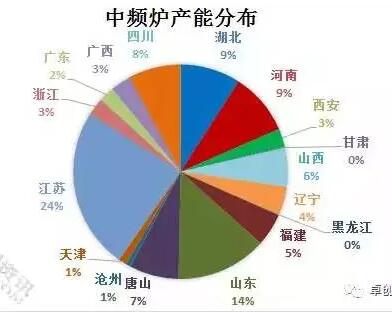
About 47.8% of steel companies in China are in East China, and 28.9% are in South and Southwest China. It can be seen that at present, most of the intermediate frequency furnace steel enterprises are distributed in the coastal areas. On the one hand, it is mainly due to the relatively developed eastern coastal areas, a large number of industrial enterprises, a large amount of scrap steel, which is conducive to its use; on the other hand, the relative construction and the large amount of steel also make the medium frequency furnace steel mills have room for survival.
However, according to understanding and analysis, in recent years, medium frequency furnace steel enterprises have a tendency to expand production inland, or in the future inland or central and western regions, intermediate frequency furnace steel enterprises may have rapid development, investigate the reasons, First, the current long process steel plants in the eastern coastal areas have the advantage of using ore freight; With the rapid construction and development of Chongqing, Chengdu, Wuhan, Changsha and other areas in recent years, the population density of the central and western regions has become larger and larger, the relatively good demand for iron and steel and the increase in iron and steel consumables. Will lead to an increase in scrap resources in these areas, and these areas have relatively higher freight costs in the use of ore, so scrap may be a wise choice. China's medium frequency furnace steel plants are also expected to be further developed in these areas.
Distribution Map of medium Frequency Furnace Steel Plant
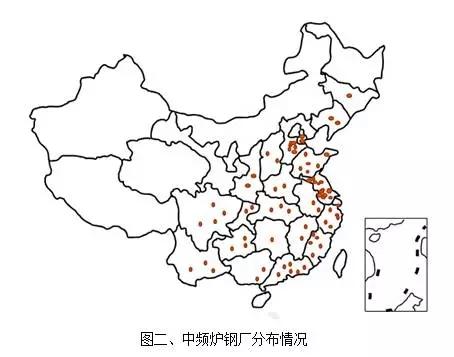
China's crude steel production capacity for intermediate frequency furnaces in 2016 was 171 million tons. In China, intermediate frequency furnace steelmaking has been developed rapidly in the past few years. Because it uses 100% scrap steel as steelmaking raw material, intermediate frequency furnace steel enterprises are very important in the consumption of scrap resources.
However, affected by the weak finishing of the industry and the squeeze of profits, there are few plans for the intermediate frequency furnace steel mills to build more capacity at present. Only a very few intermediate frequency furnace steel enterprises have plans to expand production capacity in the future, and some of the larger intermediate frequency furnace steel mills have indicated that they will upgrade their products, such as special steel products or plates, and so on. But at the same time, in order to improve the quality of products, in addition to good control of the quality of scrap, additional refining equipment, such as AOD or LF refining furnace, is still needed.
The Policy and attitude of the State towards the Intermediate Frequency Furnace
As the Chinese government focuses on environmental protection, the government's attitude towards the intermediate frequency furnace has become more stringent.
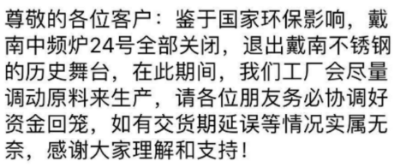
At 10:00 on May 22, 2018, news came from the mobilization meeting on the rectification and closure of the Dannan stainless steel intermediate frequency furnace that the relevant leaders of Dainan Town announced to all the owners of the intermediate frequency furnace in the town. The intermediate frequency furnace in Dainan Town will be closed at 12:00 on May 24, and it is reported that according to the spirit of instructions from the relevant departments, the entire intermediate frequency furnace in Taizhou will also be shut down! The Ministry of Industry and Information Technology said a few days ago that it will put an end to the signs of resurgence of "ground steel", and the intermediate frequency furnace also belongs to this list.
SMM SMM understands that the monthly output of stainless steel crude steel in the medium frequency furnace in Dannan area is about 100000 tons, accounting for 5 percent of the national stainless steel crude steel output. If shut down, this demand will be transferred to stainless steel mills that use primary nickel steelmaking in non-intermediate frequency furnaces. Indirectly boost demand for primary nickel. In addition, it is understood that the rectification of the intermediate frequency furnace for stainless steel plants, the short-term impact on hot rolling, thread, thread-related intermediate frequency furnace has been banned on June 30, 2017.
It is reported that according to the news of 21 May, with the consent of the State Council, The joint inter-ministerial joint meeting on resolving excess capacity and extricating itself from difficulties in the iron and steel and coal industry (hereinafter referred to as the "inter-ministerial joint meeting") is scheduled to organize eight sampling teams to 21 provinces (autonomous regions, and autonomous regions) from May 22 to June 15, 2018. (municipalities directly under the Central Government) to carry out special spot checks in the iron and steel industry to resolve excess capacity and prevent the resurgence of "ground steel". Spot checks include Tianjin, Hebei, Shanxi, Inner Mongolia, Liaoning, Jilin, Heilongjiang, Jiangsu, Zhejiang, Anhui, Fujian, Jiangxi, Shandong, Henan, Hubei, Hunan, Guangdong, Guangxi, Sichuan, Yunnan, Shaanxi and other 21 provinces (autonomous regions, municipalities directly under the Central Government). Spot checks focus on preventing the resurgence of "ground bar steel" in various regions and the resumption of excess production capacity, the elimination of backward production capacity, and the strict prohibition of new production capacity.
This is a screenshot of netizens:
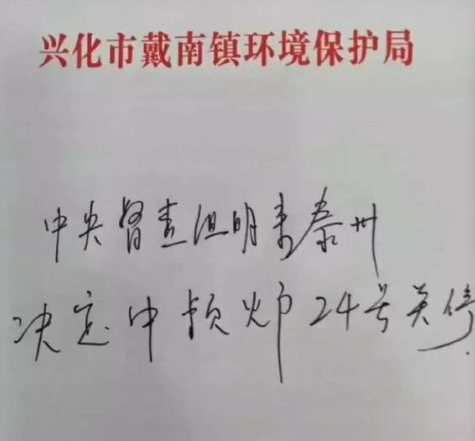
On the evening of June 24, the CCTV focus interview column, entitled "Dainan, the pain of the Transformation of stainless Steel towns," reported on the elimination of backward production capacity in Dainan Town. As soon as the program was broadcast, it aroused a warm response. The Dainan town party committee government said that it will resolutely follow the decisions of the Taizhou and Xinghua party committees and governments, earnestly consolidate the results of the shutdown of the medium frequency furnace in the previous stage, completely eliminate backward production capacity, and speed up the transformation and upgrading of the stainless steel industry.
As the report said, after decades of development, as a famous stainless steel town in China, Dainan local enterprises have become a "pain point" because of the widespread use of intermediate frequency furnaces to melt scrap steel to produce stainless steel, which has long been banned by the state. This "pain point" is the focus of the party committees and governments at the Taizhou and Xinghua levels. The previous special meeting of the party and government held in Taizhou unanimously agreed that the special action to rectify the medium (industrial) frequency furnace enterprises and the transformation and upgrading of the stainless steel industry are major issues related to the overall situation of Taizhou. It is necessary to conscientiously implement the spirit of the relevant documents of the party Central Committee, the State Council, the provincial party committee and the provincial government, as well as the spirit of instructions and instructions made by the leaders of the provincial party committee and the provincial government, and resolutely eliminate backward production capacity with the determination of backwater war and strong men breaking their wrists. We will make every effort to speed up the transformation and upgrading of the stainless steel industry in our city.
After the report was broadcast, the Taizhou Municipal Party Committee and Municipal Government attached great importance to it. Han Liming, secretary of the municipal party committee, demanded that the national policy of eliminating backward production capacity should not be questioned, and that only broken bones can be reborn, and we must grasp the elimination, promote transformation, and strive to create an example of industrial transformation and upgrading. Mayor Shi Lijun called on him to strengthen his confidence and go all out to win the battle of transformation and upgrading of the stainless steel industry.
Li Weiguo, secretary of the Xinghua Municipal CPC Committee, said that he will take this renovation as an opportunity to operate from the root causes, speed up the adjustment of the industrial structure, and improve the product quality of the stainless steel industry in the city.
Xia Aidong, secretary of the party committee and mayor of Dainan Town, said: the real solution to the pain point is not only to zero tolerance for backward production capacity, but also to speed up transformation and upgrading as the foundation. In this renovation, Dainan Town has adopted a full coverage and zero tolerance attitude towards the inspection and renovation of intermediate frequency furnaces in China, and the scope of use of power frequency and intermediate frequency induction furnaces is defined according to the Steel Association (2017) 23. Strictly define and dismantle all non-compliant intermediate frequency furnaces used to melt scrap steel to produce stainless steel.
According to reports, because stainless steel smelting is the upstream core link of the stainless steel industry chain, the renovation of the intermediate frequency furnace will obviously bring many contradictions and problems such as the broken chain of the industrial chain. In this regard, Xinghua City has set up a leading group for the transformation and upgrading of stainless steel, on the one hand, to resolve current contradictions, and actively guide and help solve the problems such as the lack of raw materials in downstream enterprises, the digestion of raw materials in stock in medium-frequency furnace enterprises, and the resolution of financial risks. On the other hand, focusing on long-term and high-quality development, well-known domestic experts are invited to participate in the formulation of the "implementation Plan for the Transformation and upgrading of Dannan stainless Steel Industry" and pay close attention to the organization and promotion.
Xia Aidong said that the "implementation plan" will focus on promoting the centralized recovery system, reducing smelting production capacity, adjusting and optimizing the variety structure, and expanding and strengthening the product industry, and will strive to promote the high-quality development of the stainless steel industry. Through this thorough transformation and high-quality transformation, we should really turn the Dainan stainless steel industry into a green industry and enrich the people.
Environmental Protection Policy strictly speeds up the Transformation and upgrading of Intermediate Frequency Furnace
Under the strict policy of national environmental protection, the intermediate frequency furnace began to move towards a new road of transformation and upgrading.
On August 24, the Taizhou Municipal Government held a forum in Dainan Town to support the transformation and upgrading of Dainan Town, and seriously planned the working ideas and measures for the transformation and upgrading of Dainan Town, so as to promote the transformation and upgrading of Dainan Town and build a famous stainless steel town in China.
Dainan stainless steel products industry has a large scale and strong market competitiveness, and has gradually developed into a pillar industry of entrepreneurship and innovation, enriching the people and strengthening the town. However, in the long-term development, it has also accumulated some outstanding problems, such as scattered industrial layout, weak urban infrastructure, tight constraints on resources and environment, weak ability of sustainable development and so on.
In order to lead the rebirth of stainless steel enterprises, while carrying out the special renovation of medium frequency furnaces, Dannan Town has taken the initiative to plan for industrial transformation. This paper studies and formulates the "Dainan Town" regional limited batch "rectification and Reform Action Plan", "Dainan Town pollution Prevention and Control campaign 2018-2019 Action Plan", "Dannan stainless Steel Industry Transformation and upgrading Plan". In order to obtain authoritative certification for the implementation plan for the transformation and upgrading of the stainless steel industry, the town actively went to the relevant departments of the state and provinces to report on the implementation plan for transformation and upgrading, which was approved and supported by the National Development and Reform Commission, the Ministry of Industry and Information Technology, and the provincial government. It has created a good external environment for Dainan's transformation and upgrading. After that, the town revised and adjusted the target orientation of transformation and upgrading, and formed the "1354" transformation and upgrading plan, which laid a solid foundation for promoting the transformation and upgrading development in an all-round way.
It is understood that the "1354" transformation and upgrading plan of Dainan Town is as follows:
1. "1": create a famous stainless steel town. Clear industrial positioning, highlight effective investment, pay attention to landscape design, gather high-end elements, innovative mode of operation.
2. "3": push forward the "three key projects". Industrial transformation project: promote the centralized recovery system, reduce smelting production capacity, adjust and optimize the variety structure, integrate and enhance rolling capacity, expand the product industry, do business logistics, and implement brand standard strategy. Urban construction promotion project: adhere to planning guidance, implement the "integration of multi-rules and regulations", speed up the construction of transportation facilities, improve urban functions, adhere to equal emphasis on construction and management, and improve the level of management. Ecological optimization project: implement the construction of central heating infrastructure in the park, speed up the environmental renovation of coal-related enterprises, speed up the construction of industrial sewage treatment plants in the park, enhance the capacity of domestic sewage treatment, and speed up the establishment of provincial eco-industrial parks. We will strengthen the ecological treatment of the water environment, carry out actions to prevent and control soil pollution, step up the treatment of industrial solid waste, and carry out comprehensive improvement of the rural environment.
III. "5": perfecting the "five centralized schemes". Market concentration, smelting concentration, pickling concentration, quality inspection concentration, logistics concentration.
4. "4": define the "four major directions of development". Consolidate the characteristics of wire, improve the quality of bars, maintain the size of profiles, tap the potential of the plate market.
The meeting proposed that the transformation and upgrading of Dainan Town should be based on "high point positioning, high-end leadership," take the implementation of the "1354" strategy as the starting point, and speed up the promotion of industrial levels, urban construction functions, and ecological environment. Build a national industrial transformation and upgrading demonstration zone, strive to do in the implementation of high-quality development, walk in the forefront, make a demonstration, reshape the glory of the national stainless steel town.
And this transformation is not on paper. Dainan Town renovated 47 steel rolling enterprises in its jurisdiction, shut down 30 small steel rolling enterprises, renovated and upgraded 17, all carried out "coal to gas" transformation, all used clean energy and natural gas, and established facilities for recycling steel rolling wastewater. Zero discharge of waste water. The town's 16 serious pollution immersion gloves processing enterprises have stopped production. By the end of July, Dainan will ban and close all of them, as required by the programme. All stainless steel products are centralized pickling. Dainan Town summarizes and promotes the typical example of environmental protection forcing transformation and upgrading, and solves the problem of environmental pollution in technological innovation. Taizhou Daming Company invested 170 million yuan to introduce German Cocos Y finishing mill, eliminated the gas generators in three workshops, invested 10 million yuan in new natural gas generators, and all realized intelligent operation. With an investment of more than 6 million yuan, the water treatment system has been updated and zero pollution recycling of water has been realized. Yasheng Xinghua Branch invested 300 million yuan in the introduction of Germany Morgan MINI fixed diameter high-speed wire rod production line, all production indicators meet the national environmental protection standards. The town party committee and the government publicize this series of typical examples through various channels and popularize their experience of clean production.
Development of stainless Steel in China
Present situation and Import and Export Analysis of stainless Steel Industry in China in 2018
The output of stainless steel crude steel in China is increasing year by year, and the demand is increasing continuously.
At present, there are mainly four kinds of stainless steel production modes in China, which are standard mode, complete nickel iron type, low nickel iron + nickel plate and complete pure nickel type. Among the four modes, when the nickel price rises, the cost of the complete ferronickel type is the lowest, among which the RKEF model has more advantages, and when the nickel price falls, the production cost under the standard mode is lower. Whether the price of nickel goes up or down, the production cost of completely pure nickel is higher than the standard model. Because the impurities produced in the mode of low nickel iron + nickel plate are more and more difficult to control, it is generally less used in the production of 304 stainless steel.
With the continuous progress of China's production technology and the increasing demand for stainless steel, China's stainless steel industry has experienced a stage of rapid growth, with an average annual growth rate of 47.08% from 2002 to 2007. In 2017, China's stainless steel crude steel output of 25.7737 million tons, accounting for 53.60% of the world's stainless steel output, becoming the highest stainless steel crude steel production in the world, followed by Japan and the United States. China's stainless steel production is not only high, but also the world's leading growth rate, with an average annual growth rate of 24.27% between 2001 and 2017, much higher than the global level of 5.91%.
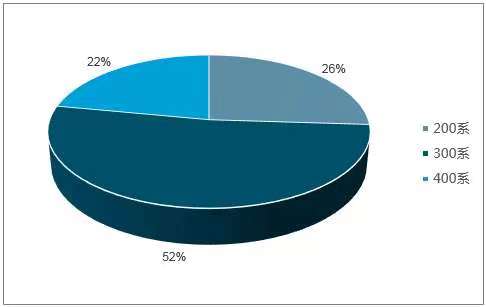
Hot rolling is the main driver of stainless steel growth, accounting for as much as 73.40%, an increase of 3.12% in 17 years compared with the same period last year, and 26.60% in cold rolling, with a decrease of 2.95% in 17 years. In the classification, 300 series steel accounted for the highest proportion, 51.84%, 200 series accounted for 25.62%, 400 series accounted for 22.53%. Last year, the output of stainless steel of all grades increased greatly, and the output of each brand this year was basically the same as that of last year.
Proportion of stainless steel production in 2017
Change of stainless Steel production capacity and New production capacity in China (10,000 tons)
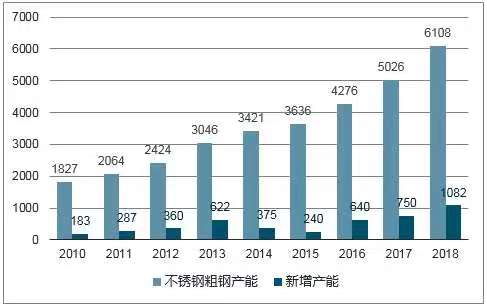
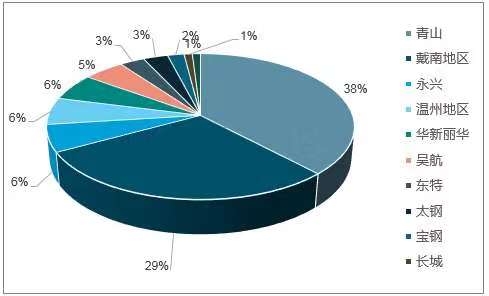
The capacity of stainless steel rod and wire rod in 2017 is 420-4.4 million tons, the capacity utilization rate is about 75%, and the actual output in 2017 is about 3.2 million tons.
Production capacity Distribution Map of stainless Steel rods and wires in China in 2017
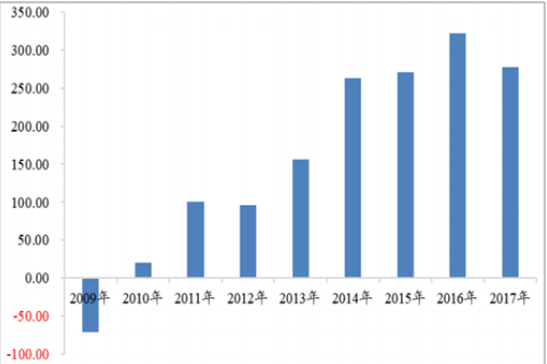
The import quantity of stainless steel showed a fluctuating downward trend as a whole. In 2010, China officially realized the net export of stainless steel, and the net export volume increased continuously, from 205500 tons in 2010 to 2.772 million tons in 2017. The compound annual growth rate was 45.02%.
Net Export of stainless Steel in China from 2009 to 2017 (10,000 tons)
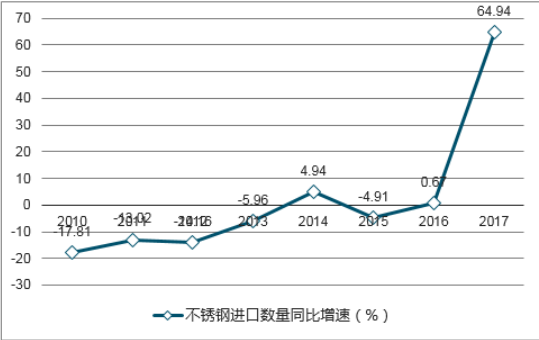
According to the latest data from the stainless Steel Branch of the China Special Steel Enterprises Association, the country imported 621000 tons of stainless steel in the first quarter of 2018, an increase of 393000 tons, or 188.9 per cent, over the same period last year. From the point of view of import structure, hot rolled medium and thin wide band steel, cold rolled stainless steel sheet and hot rolled stainless wire rod are the main imported steel.
Year-on-year change in import quantity of stainless steel in China from 2009 to 2017 (%)
Export quantity of stainless Steel in China from 2009 to 2017 (10,000 tons) and its year-on-year change (%)
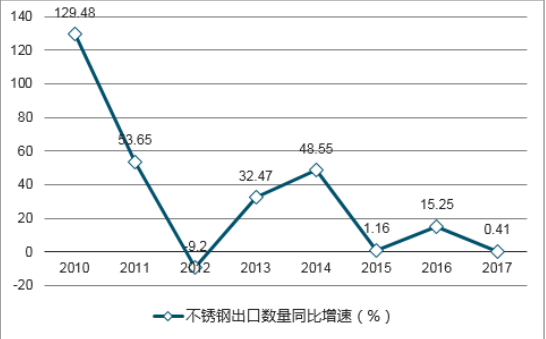
From 2009 to 2017, China's stainless steel exports grew at a compound annual growth rate of 28.37 percent, but the growth rate slowed in recent years, with stainless steel exports reaching a record high of 3.953 million tons in 2017, an increase of 0.41 percent over the same period last year. According to the latest data from the stainless Steel Branch of the China Special Steel Enterprises Association, the country exported 1.024 million tons of stainless steel in the first quarter of 2018, an increase of 123000 tons, or 13.7 percent, from the first quarter of 2017 compared with the same period last year.
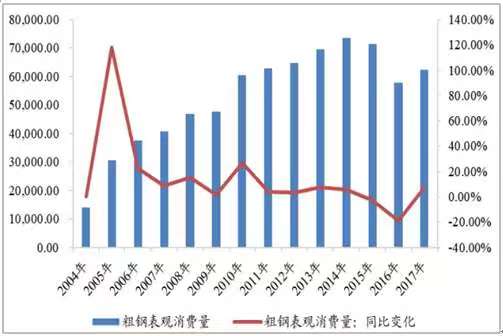
In 2017, the apparent consumption of crude steel in China was 623.5257 million tons, an increase of 7.76 percent over the same period last year, the highest growth rate in 10 years. The apparent consumption of stainless steel has continued to grow rapidly since 2008, but the growth rate has slowed in recent years. In 2017, the apparent consumption of stainless steel reached an all-time high of 19.8468 million tons, an increase of 5.37 per cent.
Apparent consumption of crude Steel in China in recent years (10,000 tons) and its change (%)
The consumption of stainless steel in tableware and white power accounts for about 45%, architectural decoration 19%, manufacturing 16%, chemical energy 12%, transportation about 7%.
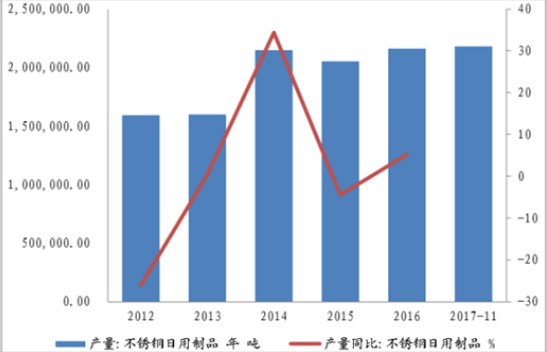
The output from 2015 to 2017 can be reflected by the output of stainless steel daily necessities. During this period, the output of stainless steel daily necessities increased steadily. In 2016, the output of stainless steel daily necessities was 2.1609 million tons, an increase of 5.23 percent over the same period last year. As of November 2017, The output of stainless steel daily necessities has reached 2.1783 million tons and is expected to grow steadily in 2017.
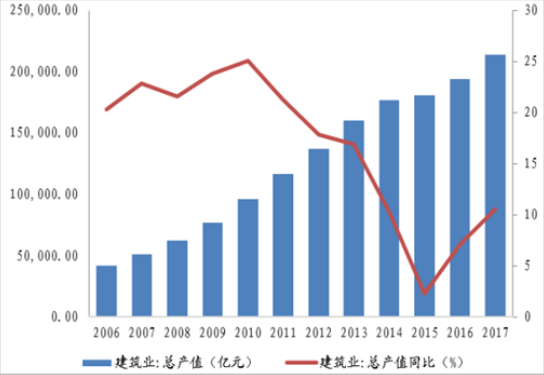
The construction field has grown steadily, and the future will be dominated by smooth operation. In 2017, the added value of the construction industry in the whole society reached 5.56 trillion yuan, accounting for 6.7 percent of the gross domestic product, and the construction industry has a solid position as a pillar industry of the national economy. The historical trend of the total output value of the decoration and decoration industry is similar to that of the construction industry, with growth rates of more than 20% from 2006 to 2007. Due to the financial crisis, the growth rate dropped to 14.51% in 2008 and recovered rapidly to more than 20% in 2009. And sustained rapid growth for five years, 2015 for the industry trough, the growth rate of only 1.3%. However, from 2016 to 2017, the total output value was 1.129516 trillion yuan and 1.201727 trillion yuan respectively, with a growth rate of 7.49 per cent and 6.39 per cent, respectively.
Total output value of China's Construction Industry (100 million yuan) and year-on-year gross output value (%) from 2006 to 2017
Guangjian subway has produced a huge steel demand market, high-quality steel demand is strong, industrial advantages to the leading gather.
Summary
On the supply side, China's stainless steel production capacity concentration is higher than that of the domestic steel industry and lower than that of its foreign counterparts. In 2017, the output of the top 10 stainless steel manufacturers in China accounted for 85% of China's total output. At the same time, the capacity utilization rate of stainless steel in China has always fluctuated at the range of 60 to 70%, and the utilization rate has been on the low side. By 2020, China's new stainless steel production capacity will reach 7.5 million tons, with a total capacity of 4 400-45 million tons, and the capacity utilization rate will still fluctuate at the range of 60 to 70 per cent.
From the consumer side, in 2017, China's stainless steel consumption reached 20 million tons, accounting for 2.58% of the total steel consumption, and will continue to maintain a trend of rapid growth in the future. In the consumption structure, tableware, products and electrical appliances accounted for 32.6%, followed by architecture, structure and decoration, accounting for 24.6%, followed by transportation, energy and industry, accounting for 14.4%, 13% and 11%, respectively. The application field of stainless steel in China is constantly expanding and rich, and the future consumption structure will be more balanced and reasonable.
From a technical point of view, China's stainless steel production technology is continuing to catch up, and even lead the development of the global stainless steel industry. The technical innovation represented by ferronickel instead of nickel plate, RKEF integrated process and cold continuous rolling technology has greatly reduced the raw material and manufacturing cost of stainless steel, established the cost advantage of Chinese stainless steel, and led to a sharp drop in the price of stainless steel in the world. In 2016, China's net exports of stainless steel reached a peak of 3.22 million tons, and high-end and characteristic stainless steel products emerged and replaced imports.
From the point of view of products, among the current domestic stainless steel products, 200 series account for 28%, 300 series account for 52%, and 400 series account for 20%. Compared with the mature market of developed countries, the proportion of 200 series stainless steel in China is obviously on the high side. With the long-term accumulation of waste stainless steel, the thorny problem of 200 series scrap steel recovery makes the industry more and more passive. In 2017, the proportion of 200 series in China has declined for the first time. It is expected that in the future, the proportion of 200 series products in China will decrease and the proportion of 400 series products will increase.
Resources
1. Stainless steel futures will be listed on the https://www.sohu.com/a/214581694_99940095 in 2018
2. Present situation and Prospect of stainless Steel in China http://www.ferro-alloys.cn/News/Details/257310
3. Present situation and Import and Export Analysis of stainless Steel Industry in China in 2018 http://www.chyxx.com/industry/201806/653723.html
4. Jiangsu Dannan stainless steel intermediate frequency furnace will be completely withdrawn or spread to https://news.smm.cn/news/100801435 in Taizhou on May 24.
5. Dannan resolutely eliminate backward production capacity and speed up the transformation and upgrading of stainless steel industry https://news.smm.cn/news/100811043
6. Dannan leads the implementation of the "1354" strategy to promote the transformation and upgrading of stainless steel industry https://news.smm.cn/news/100833434
7. Stainless steel production process https://wenku.baidu.com/view/8642a87da26925c52cc5bffb.html
8. Analysis and comparison of stainless steel production and smelting process in China https://wenku.baidu.com/view/692ae1d96294dd88d1d26b2e.html